

Ultimate Guide to AEO (Answer Engine Optimization)


Key Takeaways
AEO Is Becoming Core to Search Strategy: LLM traffic is much larger than one would expect, and APAC LLMs are growing faster than US LLMs. B2B buyers are increasingly using AI platforms such as ChatGPT, Gemini, and Perplexity to evaluate solutions. Search and AI-generated answers are converging, making it essential to optimize content for both environments.
Shift from Keywords to Topic Clusters: B2B decision-making involves different user journeys and multiple related queries. Instead of targeting individual keywords, develop pages that address clusters of related questions aligned to a single intent or topic, such as pricing, comparisons, implementation, and use cases.
Understand Question Types and Intent: AEO questions fall into three categories:
- Head: Broad and exploratory
- Mid-tail: More defined and use-case driven
- Long-tail: Highly specific and intent-rich
In B2B contexts, mid-tail and long-tail queries are more valuable as they typically reflect stronger purchase intent.
Focus on High-Intent, Product-Oriented Queries: Not all queries contribute equally to business outcomes. Prioritize those where buyers are evaluating vendors, comparing solutions, or assessing costs, as these are more likely to influence conversion.
Concentrate on the High-Impact 5%: A significant portion of SEO and AEO activity yields limited results. Focus on:
- High-intent question clusters
- Decision-stage content (e.g., comparisons, ROI, case applications)
- Market-specific considerations (e.g., pricing models, regulatory factors, local nuances)
These areas deliver the majority of measurable impact.
Validate Through Testing and Local Insights: Given the diversity of APAC markets, strategies must be validated locally. Avoid relying solely on generalized case studies. Instead, test, measure, and refine approaches based on actual performance data to ensure relevance and effectiveness.
How LLMs Work
LLMs and Next-Word Prediction
Large Language Models (LLMs), such as ChatGPT, gained widespread attention after their launch in November 2022. However, adoption across APAC took time, as businesses evaluated their reliability and use cases.
Initially, LLMs were based on next-word prediction and trained on large but static datasets (e.g., the Common Crawl). These datasets were often over a year old, meaning:
- Information was not always up to date
- Influencing outputs for marketing or product visibility was difficult
- Feedback cycles were slow, limiting optimization efforts
Shift to LLM + RAG (Retrieval-Augmented Generation)
Over the past year, LLMs have evolved to incorporate RAG (Retrieval-Augmented Generation).
In this model:
- A real-time search is performed based on the user’s query
- The LLM synthesizes and summarizes the most relevant results
For example, if a user in APAC searches: “What is the best project management software?”
- The system runs a real-time search for that topic
- It collects the latest information
- Then provides a summarized response
This allows LLMs to use fresh data (often less than a day old), which is critical for B2B buyers evaluating current competitors, their pricing, and capabilities.
AI Chat Is Converging with Search
In APAC, professionals are increasingly using AI chat interfaces as a primary research tool.
- Platforms like Perplexity were built as AI-first search engines
- Tools like ChatGPT are now integrating search-like features such as links, citations, and structured results
As a result, AI chat is no longer separate from search. In fact, it is becoming a new interface for search and discovery, especially in B2B decision-making.
AEO Is Becoming the New SEO
Because modern LLMs rely on search and real-time data, the feedback loop is now much faster. This enables influencing AI-generated answers through structured content and optimization.
For B2B organizations:
- The principles of SEO still apply
- However, they must be adapted for Answer Engine Optimization (AEO)
This includes:
- Creating content that directly answers business-critical questions
- Structuring information for easy extraction and summarization
- Ensuring content is relevant to regional markets and buyer needs
- Secure external mentions on the platforms where users spend time and make purchasing decisions, such as social UGC, YouTube videos, magazines, newspapers, and Wikipedia
In this evolving landscape, AEO is not a replacement for SEO, but its natural extension in an AI-driven search environment.
AI Adoption Is Accelerating. The Opportunity Is Now.
Mid-2024: Early Interest, Limited Adoption: In mid-2024, there was initial interest in optimizing for AI-driven answer engines (AEO), including within APAC markets. Some early frameworks and strategies were introduced, particularly in global B2B communities.
However, adoption remained limited at this stage because:
- AI-generated answers had low visibility of sources
- Measurable business impact, such as traffic or leads, was unclear
- Many organizations were still in an experimental phase
Since Early 2025, Rapid Growth in Adoption: From early 2025 onwards, interest in AEO has increased significantly across APAC B2B sectors, driven by:
- Higher usage of LLM tools among business users for research and vendor evaluation
- Increased investment in AI and AEO platforms, accelerating awareness and capabilities
- Improved user experience in AI tools, including:
- Clearly visible, clickable links
- Structured answers with sources
- Integration of traditional search elements
These changes have made AI platforms more practical for B2B discovery and decision-making.
Growth of AI in the APAC Region Over the Last Five Years
Across most APAC markets, ChatGPT continues to lead the LLM category, accounting for an estimated 70–80% of market share in terms of awareness, usage, and category dominance. It remains the primary entry point for AI adoption in both consumer and professional use cases.
At the same time, Gemini is steadily gaining momentum, particularly in markets where Google’s ecosystem has strong penetration. Its adoption is increasing as users become more comfortable with AI-assisted search, productivity, and research workflows.
A market-level view can be framed as follows:
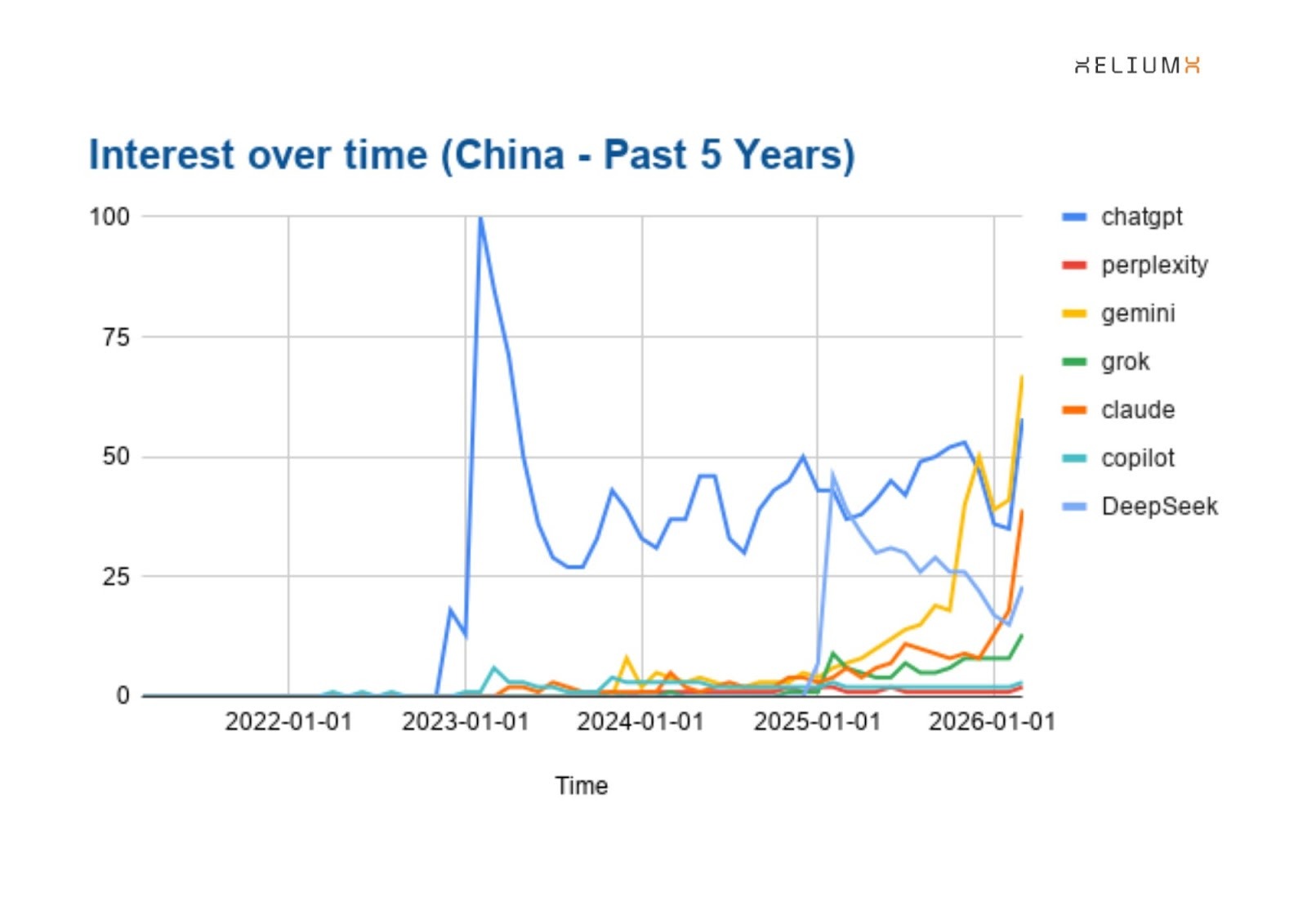
- China saw an early spike in interest around ChatGPT in 2023. However, local and regional alternatives have become increasingly important, with DeepSeek emerging as a strong and fast-growing competitor in the market.
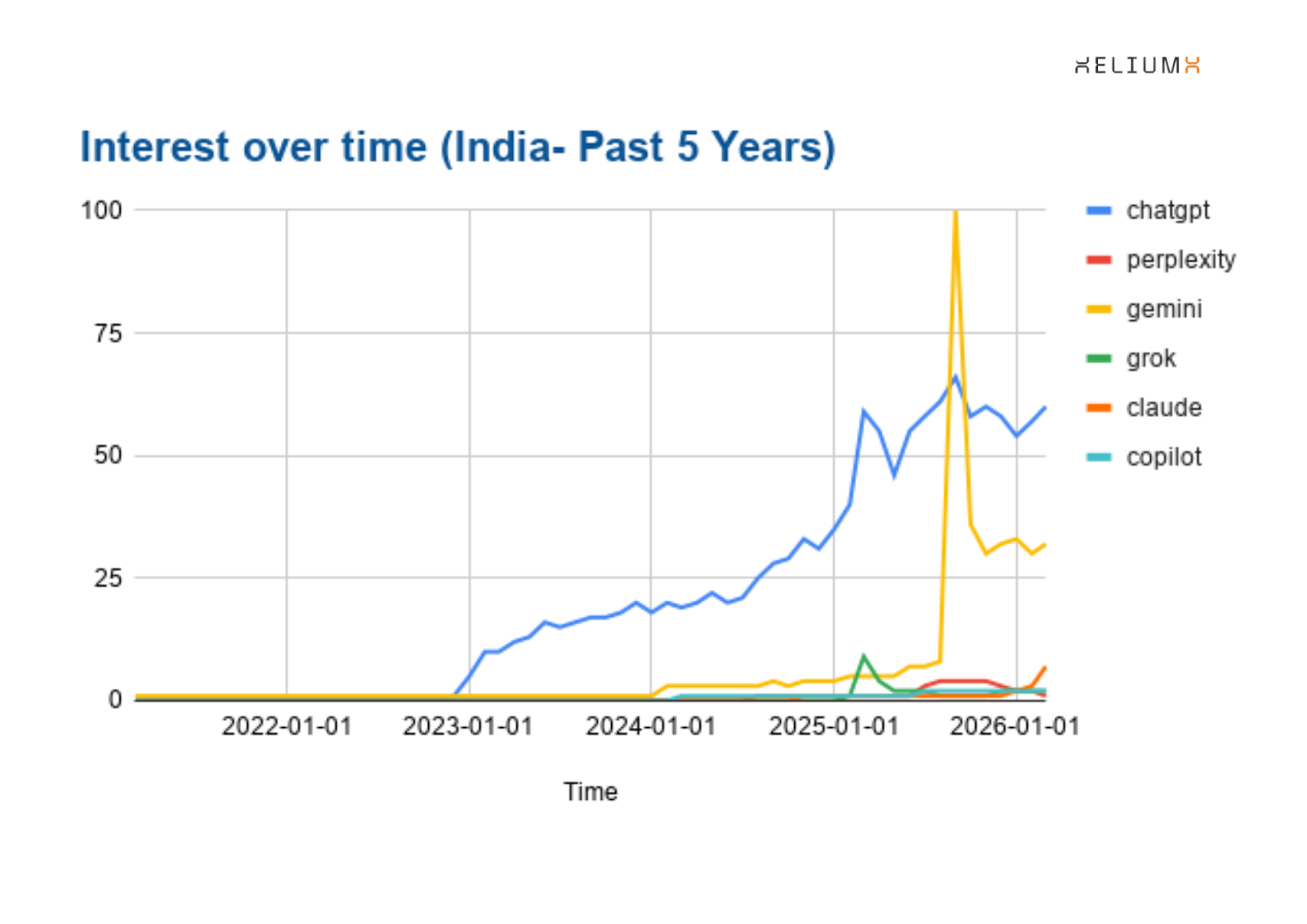
- India has shown steady and sustained growth in ChatGPT adoption, while Gemini has experienced a noticeable surge, driven by growing familiarity with Google-integrated AI experiences.
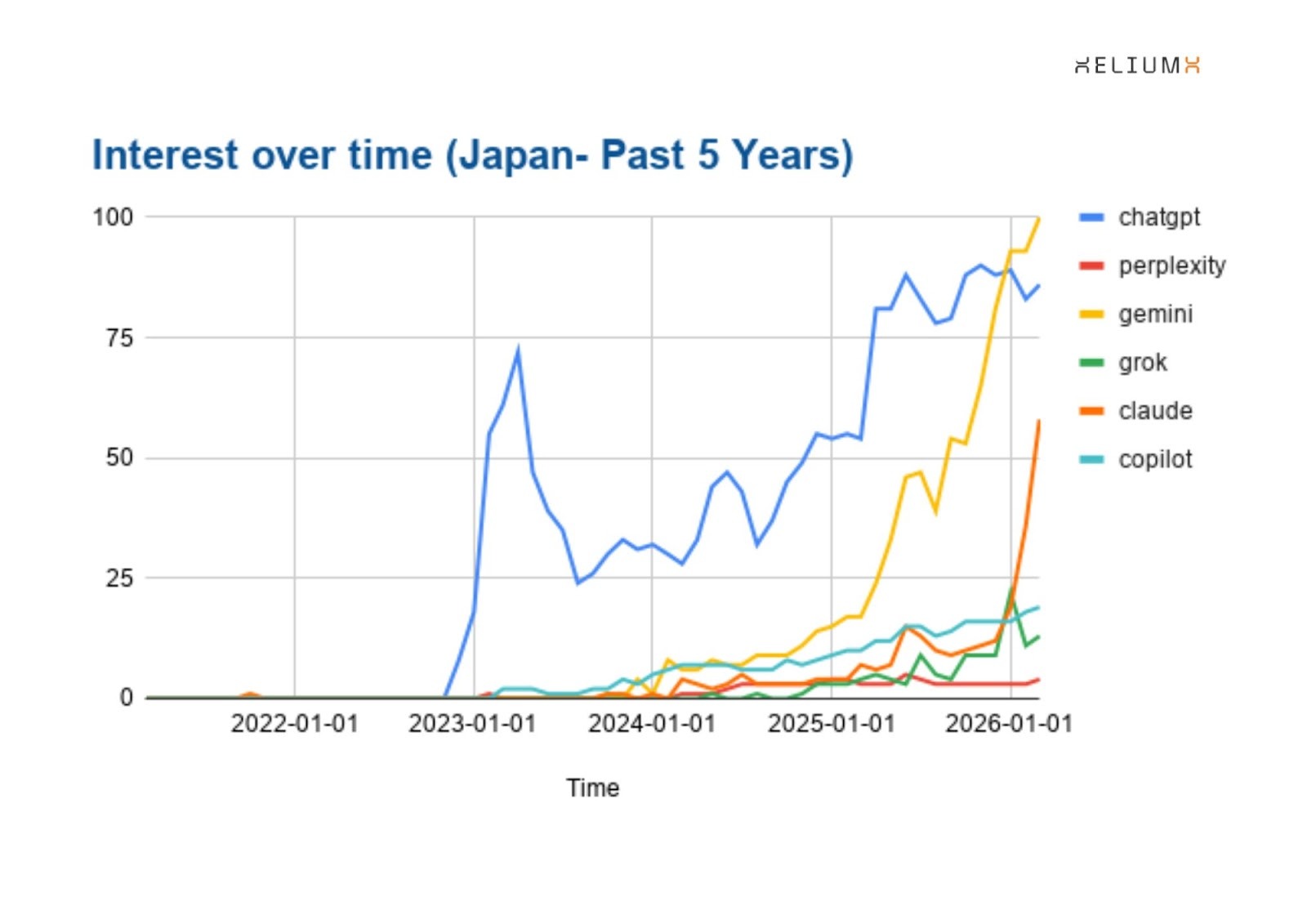
- Japan has witnessed significant growth in both ChatGPT and Gemini, reflecting increasing enterprise and consumer openness to AI tools.
- Australia and Singapore remain markets where ChatGPT clearly dominates, supported by strong digital maturity, English-language usage, and early adoption of global AI platforms.
Overall, the APAC region is seeing rapid expansion in LLM usage, with ChatGPT maintaining leadership, Gemini accelerating in several markets, and regional players becoming increasingly relevant in select geographies.
Impact on B2B Marketing and Demand Generation: As AI tools now provide clear source links, they are driving referral traffic and influencing buyer journeys.
For B2B organizations, this means:
- AI platforms are becoming a new acquisition and research channel
- Buyers are increasingly using AI to shortlist vendors and compare solutions
- Content can now directly influence AI-generated recommendations
What Does This Mean Going Forward?
The shift toward AI-driven discovery is expected to continue and strengthen.
For B2B companies in APAC:
- AEO should be treated as a strategic priority, not an experiment
- Early adoption provides a competitive advantage in visibility and influence
- Organizations that invest now will be better positioned as AI becomes a primary interface for search and decision-making
In summary, AI adoption has moved from early interest to practical business impact, making this a critical time to act.
The 5%
The 5% of SEO
In B2B, a key reality is that most SEO efforts do not deliver meaningful results. Many landing pages generate little to no traffic or impact on the pipeline.
However, SEO still drives strong outcomes because a small number of strategies and pages (typically ~5%) generate the majority of traffic and leads.
If you can identify and focus on these high-impact areas, you can achieve disproportionate business results. This is referred to as “The 5%.”
How to Find The 5%
Identifying the high-impact 5% is conceptually simple but requires disciplined execution.
The 95/5 rule applies across most B2B growth channels, and most activities have limited impact, while a few deliver 10X results.
Generate Ideas: Start by identifying potential high-impact initiatives through:
- Market and customer research within APAC
- Discussions with sales and industry experts
- Competitive analysis
- Performance data and insights
Focus on ideas aligned with buyer intent and revenue outcomes.
Test & Evaluate: Most ideas will not succeed. To assess effectiveness:
- Run structured tests (e.g., control vs. test groups, or before vs. after comparisons)
- Measure impact on key metrics (qualified traffic, conversions, pipeline)
- Validate whether the results are statistically meaningful
Reproduce Results: One-time success is not sufficient. For a strategy to be reliable:
- It should deliver consistent results across multiple tests
- It should be applicable across relevant APAC markets or segments
Only repeatable outcomes should be scaled.
A common challenge in SEO is the lack of proper testing. Many teams:
- Launch initiatives without measurement frameworks
- Assume outcomes without validating data
- Continue investing in low-impact activities
This has led to inefficiencies in SEO for years, and the same pattern is now emerging in AEO.
The 5% of AEO
AEO is still evolving, particularly in the APAC region for B2B organisations. While definitive best practices are still emerging, early indications suggest the following areas are most impactful:
New Pages: Create landing pages targeting high-intent question clusters that are not currently covered, especially those relevant to regional industries and use cases.
Content Enhancement: Improve existing content by:
- Identifying gaps in coverage
- Adding clear, structured answers to key buyer questions
- Strengthening content for decision-stage queries (e.g., pricing, comparisons, implementation)
Citation Optimization: Identify which sources are frequently referenced by AI platforms for relevant topics, and:
- Ensure your content is included among these sources
- Position your brand clearly within authoritative content
Technical SEO: In many B2B cases, technical SEO delivers limited incremental impact.
- Historically, technical optimizations were effective due to search engine limitations
- Today, many technical activities create high effort with low return
- Automated audits often produce large volumes of recommendations with minimal business value
Exceptions:
- Internal linking (improves discoverability and authority flow)
- Page rendering (ensures content is accessible to search engines)
Technical AEO
A similar trend is expected in AEO. There is a growing focus on:
- Page speed
- Crawlability
- Indexation
- Technical errors
While these may be important, their direct impact on business outcomes remains unclear.
Our recommendation for B2B teams:
- Be cautious about over-investing in technical AEO
- Prioritize content quality, relevance, and buyer intent
In short, for B2B organizations, success in SEO and AEO depends on:
- Identifying and prioritizing the small set of high-impact activities
- Testing and validating strategies rigorously
- Focusing on initiatives that directly influence buyer decisions and the pipeline
The goal is not to do more, but to focus on the 5% that drives the majority of results.
AEO Topics
Targeting by Keyword: In traditional SEO, especially in earlier stages, teams created separate pages for each keyword to achieve exact-match results for search queries.
This approach led to:
- Large volumes of pages (often programmatically generated)
- Coverage of thousands or millions of search queries within a category
This is how Programmatic SEO became widely adopted.
At that time, search engines had a limited understanding of context and intent, so ranking depended heavily on targeting specific keywords.
SEO Topics & Topic Research
As search evolved, the focus shifted from individual keywords to topics. A topic is a group of related keywords that share the same underlying intent.
For example, in an APAC B2B context:
- “best CRM software for SMEs”
- “CRM tools for small businesses in Singapore”
- “affordable CRM solutions APAC”
All represent a similar intent and can be addressed within a single, well-structured page.
Why This Matters for B2B?
B2B buyers in APAC typically:
- Ask multiple related questions during their research process
- Look for localized, use-case-driven information
- Evaluate solutions across several dimensions (pricing, features, compliance, etc.)
By organizing content around topics instead of individual keywords, businesses can:
- Cover broader buyer intent more effectively
- Reduce content duplication
- Improve visibility across multiple related queries
This approach is more aligned with how modern search engines and AI-driven answer engines understand and surface content.
Question Research
Targeting by Questions” The same approach used in SEO, which is grouping keywords into topics, also applies to AEO, but with a shift toward questions instead of keywords.
In AEO, the goal is not to target single queries, but to address multiple related questions with the same intent.
For APAC B2B, this reflects how buyers research:
- They ask several related questions
- They refine their queries as they evaluate solutions
AEO Topics & Question Research: An AEO topic is a cluster of questions that share a similar intent. Instead of creating a page for each question, create a single page that answers multiple related questions.
For example:
- “Best CRM software for SMEs”
- “CRM tools for small businesses in Singapore”
- “Affordable CRM solutions in APAC”
These can all be addressed within a single, well-structured page.
Search Volume of Questions
In SEO, keyword search volume comes from Google Ads data.
In AEO:
- There is no direct data source for question volume yet
- AI platforms do not provide visibility into query frequency
This means APAC B2B teams must rely on:
- Keyword data as a proxy
- Customer and sales insights
- Market knowledge
Reliable data sources are expected to emerge as AI platforms introduce advertising.
The Long Tail of SEO Keywords
SEO classifies keywords into:
- Head terms — high volume, high competition
- Mid-tail terms — moderate volume and lesser competition
- Long-tail terms — low volume, highly specific
SEO Topic Landscape
Modern search engines group keywords into topics. This allows:
- One page to target head, mid, and long-tail keywords together
- A shift from keyword-level optimization to intent-based optimization
The Long Tail of AEO Questions
AEO follows a similar structure, but with questions:
- Head questions — broad and competitive
- Mid-tail questions — more specific and use-case driven
- Long-tail questions — highly detailed and intent-rich
In APAC B2B, mid-tail and long-tail questions are more valuable, as they indicate stronger buying intent.
Search vs. Conversation
In traditional search, user behaviour is query-based and independent. Each search is treated separately, with no memory of previous queries. A user may search for “best ERP software,” then refine it to “ERP for manufacturing,” but each step is disconnected.
In contrast, AI chat is conversational and contextual. Users begin with a broad question and then follow up with questions that build on earlier responses. For example, a user may start with “best ERP software,” then ask “which works for manufacturing?” followed by “which supports local compliance?” The system retains context across the conversation.
As a result, content must go beyond answering a single question. It should address both the primary query and the likely follow-up questions that a B2B buyer may ask during the decision process.
Owned vs. Earned
In SEO, most value comes from owned visibility, where your website ranks directly for relevant queries.
In AEO, answers are generated by combining information from multiple sources. Visibility comes from both owned content (your website being referenced directly) and earned visibility (your brand being cited or mentioned in third-party sources).
For APAC B2B, the approach varies by query type. Broad, high-level questions typically rely more on earned visibility, as AI platforms often reference publisher or aggregator sites. More specifically, high-intent questions are more likely to surface owned content, making them easier for companies to influence directly.
Product Questions
Not all questions deliver business value in AEO. Informational queries, such as “What is ERP?”, typically provide general knowledge and rarely include product recommendations, making them low value for B2B outcomes.
In contrast, product-focused queries like “Best ERP software for mid-sized companies in India” often include vendor suggestions and indicate clear buying intent. For APAC B2B organizations, the priority should be on Product Questions that highlight solutions, compare vendors, and signal that the buyer is actively evaluating options.
Where Products Appear Most Often
Product visibility in AI-generated answers is not uniform across categories. It is significantly higher in areas such as technology and SaaS, finance, business tools, commerce and services.
In contrast, categories like news and general informational content tend to show fewer or no product recommendations. This makes AEO particularly relevant for APAC B2B companies, especially those operating in technology- and service-driven sectors where buyers are actively seeking solutions.
Question Research Tools
At present, there are no standardized tools specifically designed for AEO question research. As a result, most organizations rely on indirect methods such as converting existing keyword data into question formats and leveraging insights from sales, customer support, and market interactions.
Emerging platforms like Helium X are beginning to address this gap by transforming keyword data into structured question clusters and supporting AEO-focused research. These approaches help approximate how users interact with AI platforms today.
For APAC B2B organizations, the focus should shift from individual queries to question clusters, with an emphasis on mid- and long-tail questions that demonstrate strong intent. Content strategies should be designed for conversational journeys, addressing both primary and follow-up questions. At the same time, it is important to balance owned content and earned visibility, as both play a role in how AI platforms generate and prioritize answers.
Recommendations
If you are a B2B organization and exploring AEO in the APAC region, the following actions are recommended:
Invest in AEO Now: AEO is growing rapidly across APAC, with increasing adoption of AI tools in B2B research and decision-making. Referral traffic from AI platforms is rising, and optimization strategies are becoming clearer. This is the right time to invest and build an early advantage.
AEO Topics: Identify and prioritize the most important AEO topics relevant to your business. Track how your brand and competitors appear across these topics in AI-generated answers
New Pages: Create landing pages for high-intent AEO topics that are not currently covered. Focus on topics aligned with buyer needs, use cases, and regional requirements in APAC.
Content Enhancement: Review existing pages and identify gaps. Improve content by:
- Adding answers to key buyer questions
- Expanding coverage for decision-stage queries
- Making content more structured and comprehensive
Citation Optimization: Identify which sources are most frequently cited for your target topics. Then:
- Ensure your content is referenced in those ecosystems
- Position your brand clearly within high-authority content
Technical AEO: Be cautious with technical AEO efforts. Similar to technical SEO, these activities often require significant effort but deliver limited impact in most cases. Prioritize content, relevance, and intent over technical adjustments.
AEO Tools: There are many AEO tracking tools available, but most serve a similar purpose: tracking how often your brand appears in AI answers. Select a cost-effective tool that meets your requirements rather than over-investing in complex platforms.
Evaluate and Reproduce Results: Be cautious when relying on external case studies or blog content, as results may not always be transferable. Instead:
- Test strategies internally
- Measure outcomes rigorously
- Reproduce results before scaling
This approach helps identify the 5% of AEO activities with the highest impact.
Share Learnings: As you test and validate strategies, document and share insights across teams. Continuous learning is critical in this evolving space. As more findings emerge, platforms like Helium X and industry practitioners will continue to share insights to help refine AEO strategies.



Master the fundamentals of Generative AI in just one day. Learn how to simplify and harness...

Master the fundamentals of Generative AI in just one day. Learn how to simplify and harness...
